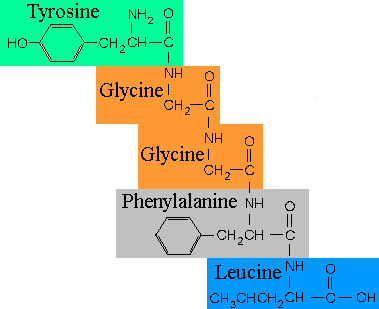
Fig 1.: Chemical structure of Leu-Enkephalin
Leucine Enkephalin as Treatment of Inflammatory Parkinsonism (a Case Report)
Ines Niehaus
Comments to: Ines_Niehaus@gmx.de
Poster presentation at the
9th
International Conference AD/PD 2009 in Praha
Introduction: The neurotransmitter leu-enkephalin is a pentapeptide with
the amino acid sequence of tyrosine, glycine, glycine, phenylalanine,
leucine. Leu-enkephalin is neuroprotective in femtomolar concentrations
in inflammatory lipopolysaccharide (LPS) animal models of parkinsonism
and reduces the sezernation of anti-LPS- IgM-antibodies of B-cells.
LPS are part of outer membranes of Gram-negative bacteria.
Method: An oral treatment with leu-enkephalin in µmol concentration
was started in a case of lipopolysaccharide-induced parkinsonism.
Results: The first effect was a shortly pain in bones with transient
depression of blood pressure. Muscle relaxing effects started after 30
min. Strong improvement of activity of sensory nerves occured within 5
hours. LPS-induced conduction blocks of N. peronaeus were shown in
sensory nerve action potentials before. Stiffness and hypokinesia were
reduced. Walking abilities improved with reoccuring of the missed left
arm swing. One dose of the daily therapy showed long-lasting positive
effects up to 72 hours. The patients chronically elevated
anti-LPS-IgM-antibodies levels were lowered.
Conclusions: The negatively charged LPS is able to bind to positively
charged pentapeptide sequences of important neuronal receptor proteins:
1) alpha2-delta2-subunit of voltage-gated calcium channels
2) NADPH oxidase NOX5
3) Enzyme myosin light chain kinase 2 of skeletal muscles
Leu-enkephalin might be able to prevent the binding of LPS to these
peptides with restoring of the protein function including reduced amount
of LPS-caused conduction blocks. Leu-enkephalin in µmol concentration
shows excellent anti-parkinsonian and anti-inflammatory effects of much
more intensity than L-dopa and pramipexole administered for years in the
patient.
Lipopolysaccharides (LPS), Sepsis, and Neurodegeneration
LPS are highly biohazardous bacterial O-antigens. E. coli LPS injected
in ng in humans or animals are causing transient mild sepsis-like
symptoms with stimulation of the immune system (B-cells, phagocytes).
LPS in µmol doses are causing sepsis and lethal septic shock due to
failure of multiple organ systems. Sepsis survivors are suffering from
long-term neurological seroquaeles like critical illness encephalopathy,
polyneuropathy and also parkinsonism.1
Sepsis-induced polyneuropathy mostly severe occurs in Nervus peronaeus
with nerve conduction blocks and myositis with muscle atrophy and
weakness in feet and legs like in the described patient.
Leu-Enkephalin
The neurotransmitter leu-enkephalin is a pentapeptide with the amino
acid sequence of tyrosine, glycine, glycine, phenylalanine, leucine.
Fig 1.: Chemical structure of Leu-Enkephalin
Storage of Methionine-Enkephalin in the brain
Met-Enkephalin deficiency is known in brains of patients with PD. In
healthy subjects met-enkephalin levels were highest in the caudate
nucleus and putamen and lowest in the hippocampus and cerebral cortex.
In PD 80-95% reduced Met-enkephalin concentration was known in the SN
and ventral tegmental area but not in the caudate nucleus and putamen
despite the lack of dopamine in all four regions of the brain.
Enkephalin immunoreactivitity in mesencephalon has been observed in
nerve terminals surrounding the DA neurons - maybe in astrocytes.2.
LPS-induced PD in rats the astrocytes are also degenerated, maybe also
the stores of enkephalins in astrocytes.
Leu-Enkephalin improves the cerebral blood flow
The opioid neuropeptide leu-enkephalin improves pial microcirculation
and cerebral blood flow in moderate to severe brain ischemia 3.
Restored the cerebral blood flow and
vasomotor reaction of the pial micro vessels, rapidly and intensively
improved peripheral and central lymph circulation against the background
of decreased cardio- and homodynamic parameters.
Leu-Enkephalin stimulates the lymph flow
Lymphostimulation is a effective method of treating ischemia. Leu-Enkephalin
Is a most effective immunostimulator with direct lymph stimulating
effects. The peripheral Leu-Enkephalin-induced lymph stimulation is attended
by preventaion or restoration of the damaged local circulation in the
ischemized brain cortex. 3
In rats, the response of pial vessels to I.p. injected Leu-Enkephalin (40µg/kg)
is studied after and before bilateral occlusion of common carotid
arteries. Leu-Enkephalin preserves the circulation stability inspite of lowered
arterial pressure, bradycardia, increased local circulation in the brain
cortex by 50-70%, and intensification of the lymph flow in micro- to macro
vessels and absence of mortality in the first hours of occlusion. The
lymph flow was measured by puncture of the thoracic lymphatic duct.
Initially inactive mesenteric microvessels of the small intestine began
to contract intensively with acceleration of the lymph flow velocity in
mesenteric micro vessels.4
Microglial NADPH oxidase mediates Leu-Enkephalin dopaminergic
neuroprotection
Leu-Enkephalin is neuroprotective to LPS-induced damages of dopaminergic
neurons at femtomolar concentration (10-15 to 10-13) through
anti-inflammatory properties. The tetrapeptide
des-tyrosine leu-enkephalin and the tri-peptide
glycine-glycine-phenylalanine is also neuroprotective. But they are only
neuroprotective in PHOX+ cell cultures. PHOX is a catalytic subunit gp91
of the NADPH-oxidase complex. NADPH oxidase is an inducible elektron
transport system in phagocytic cells causing free radicals H202.
6
Enkephalins are able to reduce the LPS-induced stimulation of B-cells.
Receptors for opioid peptides like met and leu-enkephalins are present
on immune cells like B-cells. IgM-production of LPS-stimulated B-cells
were inhibited by low concentrations of Met-enkephalin (10-16 to 10-10)
from 30-50% in compared with LPS-stimulated controls, where as higher
concentration 10-8 are not effective. The results show that IgM and IgG3
production was inhibited by ultralow concentration of Met-Enk.5
Parkinson's disease (PD) and LPS:
In rats, intranigral injections of LPS results in a rapid inflammatory
activation of microglia followed by an acute and permanent damage of
dopaminergic neurons. Other neurons are not affected perhaps due to the
highest density of microglia in the SN with increased sensitivity to the
LPS-induced inflammation.7
In mice, a single systemic i. p. injection of LPS results in a chronic
neuroinflammation with activated microglia and increased TNF-alpha in
the brain and a delayed and progressive loss of the dopaminergic neurons
(a first detectable loss of 22% after 7 months, 47% loss after 10
months). The pattern of damages of the dopaminergic neurons in the
striatum is symmetrically. Microglia cells were activated 3 h post LPS
injection not only in the SN but also in the hippocampus and cortex!8
Case Report: Results of Examinations in the Case Report:
FTIR-analysis of blood sample in 2003:
The result of a Fourier transform infrared spectroscopy (FTIR-analysis)
showed a high content of Salmonella minnesota S-LPS (ca. 1/3 of the
blood sample was contaminated with LPS). The LPS was 100% identified as
Salmonella minnesota S-LPS.9
Positron emission tomography with Fluoro-Dopa on February 20th, 2001:
The F-Dopa-PET shows in 2001 ca. 70% loss of dopaminergic function
marked by severe reduction of the decarboxylase activity in both Nuclei
caudatii (quotient Nucl. caud right/Occ: 1.52; Nucl. caud. left/Occ:
1.54 ) without difference of sides and a moderate reduction of the
functionality of putamen (quotients: putamen right/Occ:1.78; putamen
left/Occ: 1.71).
LAL test of cerebrospinal fluid on April 3rd, 2000:
The result of a chromogenic limulus lysate assay (LAL) of the
cerebrospinal fluid was 6600 pg LPS/ml CSF.
Positron emission tomography with FDG on July, 10th 1998
Cerebral glucose metabolism was determined with [Fluorine-18]
fluoro-2-deoxy-D-glucose (FDG) using positron emission tomography. In
summary the reduction of glucose utilization was ca. 70% in the gyrus
frontalis, ca. 80% in the gyrus prae- and postcentralis, and ca. 75% in
the gyrus temporalis (normal range 100%).
Summary of the Case Report
This is the first case report describing a treatment with leucine
enkephaline in µmol concentration in a 36-yrs old female patient 14
years living with a long-lasting persistent endotoxemia causing
chronically systemic and neuronal inflammation with progressive
parkinsonism after one single accidental contamination with 10 µg highly
purified Salmonella minnesota S-LPS in 1995. The LPS has neither been
detoxified nor eliminated from the body proven by a LAL test of the CSF
in 2001 (6600 pg LPS/ml CSF) and by a FTIR-analysis of a blood sample in
2003.
Symptoms of Parkinsonism in May 2001 without any treatment
Rigidity in 4 extremities most severe in the neck (typical for
encephalic PD), bradykinesia, cogwheel phenomenon; resting tremor;
diadochokinesia; missing arm swing and dragging of the leg on the left
side; tendency of micrography in handwriting, fine motor skills
restricted and general retardation of movements. A treatment with L-Dopa
and amantadine is improving symptoms but the patient is unable to
tolerate any kinds of dopamine agonists because of severe negative side
effects (vertigo, nausea, weakness, sleeping attacks).
Effectiveness of Leu-Enkephalin in the Case Report
Long-lasting improvement of symptoms of Parkinsonism due to orally
administered leucine enkephalin in µmol concentration in an aqueous
solution.
First effects after first three doses
The first effect was a shortly pain in bones especially of the hips with
transient depression of blood pressure. Muscle relaxing effects started
after 30 min. Strong improvement of activity of sensory nerves occured
within 5 hours. LPS-induced conduction blocks of N. peronaeus were shown
in sensory nerve action potentials before.
Stiffness and hypokinesia were reduced. Walking abilities improved with
reoccuring of the missed left arm swing. One dose of the daily therapy
showed long-lasting positive effects up to weeks. The patients
chronically elevated anti-LPS-IgM-antibodies levels were lowered.
Long-term effects
after 11 doses (last one in the middle of January 2009):
- Permanent improvement of the movability of the left side with
re-occuring left arm-swing during walking
- left leg is less cramped, longer condition in standing position with
less or reduced pain in the leg
- possibility for walking for a longer distance (up to 3 km)
- improved balance, no more falls
- improving pattern of walking
References:
1) Alasia DD, Asekomeh GA, Unachuku CN.
Parkinsonism induced by sepsis: a case report.
Niger J Med. 2006; 15(3):333-6.
[PubMed]
2) H. Taquet, Javoy-Agid F, Lesselin F, Agid Y.
Methione-Enkephalin deficiency in
brains of patients with Parkinson's Disease.
Lancet 1981; 317(8234):1367-1368.
[PubMed]
3) Khugaeva VK, Bespalova ZD.
Effects of Leu-Enkephalin analog on cerebral circulation in cerebral
ischemia of different severity.
Bulletin of Exp. Biol. Med. 1998; 11: 1100-1102.
4) Khugaeva VK, Aleksandrov PN, Aleksandrin VV.
Effect of opioid lymph stimulation on the microcirculation in pial
vessels of the ischemized rat brain.
Bulletin Exp. Biol. Med. 1995; 129(1): 100-105
5) Das KP, Hong JS, Sanders VM.
Ultralow concentrations of proenkephalin and [met5]enkephalin
differentially affect IgM and IgG production by B cells.
J Neuroimmunol 1997; 73(1-2): 37-46.
[PubMed]
6) Qin L, Liu Y, Qian X, Hong JS, Block ML.
Microglial NADPH oxidase is a novel target for femtomolar
neuroprotection against
oxidative stress.
Ann N Y Acad Sci. 2005; 1053: 107-20.
[PubMed]
[free article]
7) Castano A, Herrera AJ, Cano J, Machado A.
The degenerative effect of a single intranigral injection of LPS on the
dopaminergic system is prevented by dexamethasone, and not mimicked by
rh-TNF-alpha, IL-1beta and IFN-gamma.
J Neurochem. 2002; 81(1):150-7.
[PubMed]
8) Qin L, Wu X, Block ML, Liu Y, Breese GR, Hong JS, Knapp DJ, Crews FT.
Systemic LPS causes chronic neuroinflammation and progressive
neurodegeneration.
Glia. 2007; 55(5):453-62.
[PubMed]
9) Kim S, Reuhs BL, Mauer LJ.
Use of Fourier transform infrared spectra of crude bacterial lipopolysaccharides
and chemometrics for differentiation of Salmonella enterica serotypes.
J. Appl. Microbiol. 2005; 99(2):411-7.
[PubMed]
Please send any comments or questions to the author and website editor.
e-mail: Ines_Niehaus@gmx.de
This website was edited on March, 8th 2009.
Last update: May, 8th 2010.